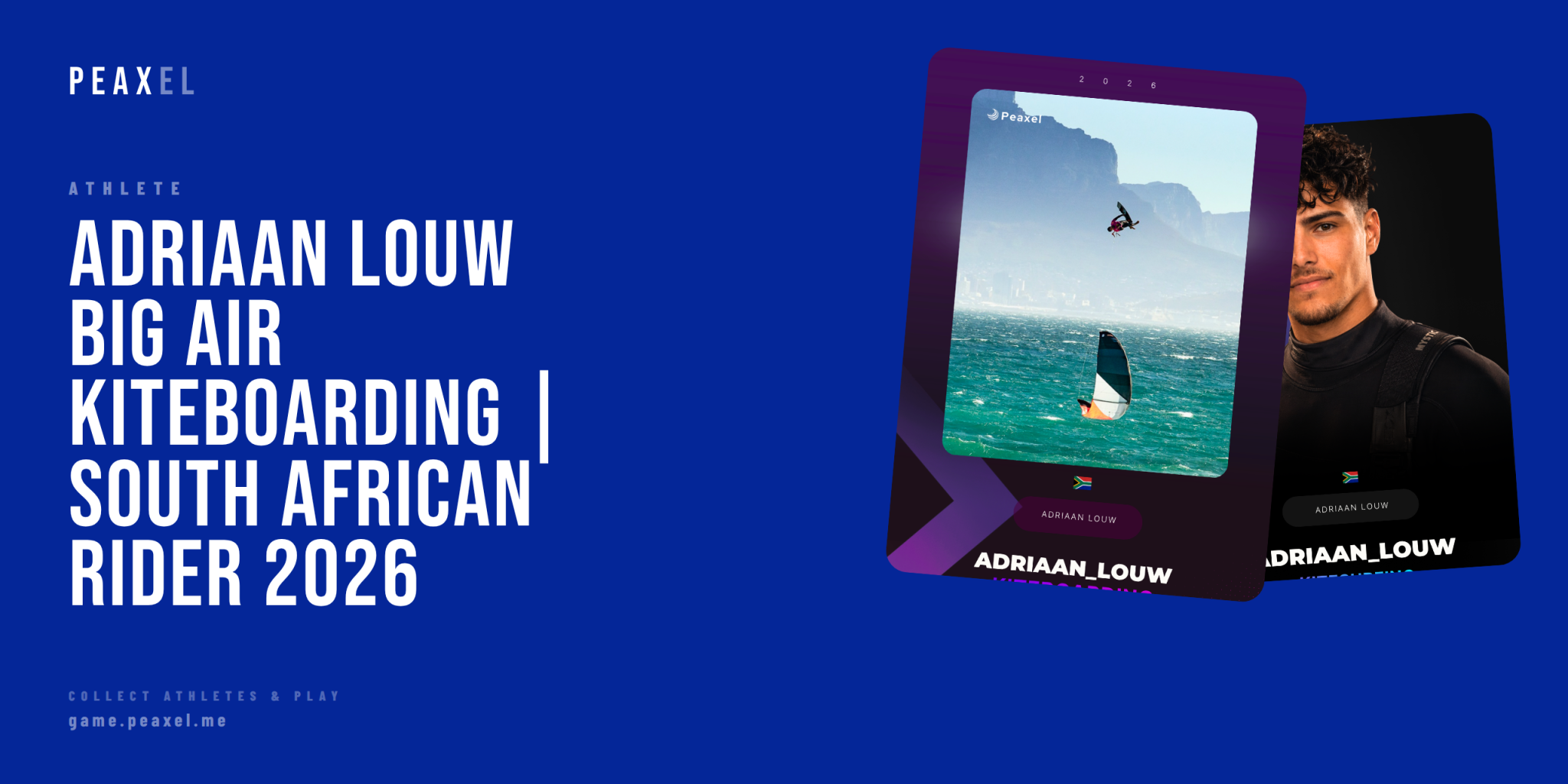
From Kite Beach to the World Stage: Adriaan Louw’s Big Air Journey
At just 19 years old, Adriaan Louw represents a new generation of Big Air kiteboarders emerging from South Africa’s legendary Cape Town coastline. Born on December 5, 2006, he grew up surrounded by some of the most consistent and powerful wind conditions on the planet, learning to harness the elements at Kite Beach before he turned eleven.
Big Air kiteboarding is among the most spectacular disciplines in action sports. Athletes launch themselves dozens of meters into the sky, executing complex rotations, kiteloops, and board-off maneuvers while suspended by nothing but wind and a kite. It demands courage, technical precision, and an intimate understanding of wind dynamics that takes years to develop.
For Adriaan, that education began early. His bio notes he started kitesurfing around age 10, which means he has nearly a decade of experience reading the wind patterns that sweep across Table Bay. That foundation is critical in Big Air, where split-second decisions determine whether a jump becomes a highlight reel or a hard lesson.
Training Ground: Why Cape Town Produces Elite Kiteboarders
Cape Town’s Kite Beach is not just a training spot—it is a global pilgrimage site for Big Air athletes. The combination of consistent thermal winds, flat water launch zones, and proximity to open ocean swells creates conditions that are nearly impossible to replicate elsewhere. World record holder Hugo Wigglesworth, who broke the 40-meter barrier in December 2025, specifically travels to Cape Town for his biggest attempts.
Growing up in this environment gives Adriaan a structural advantage. While riders from other regions might chase wind windows for weeks, Cape Town athletes can train almost daily during the summer season. This volume of repetition accelerates skill development in ways that cannot be shortcut.
Adriaan’s preferred trick—the kiteloop board-off double tornado—illustrates his technical ambition. This maneuver requires releasing the board mid-air, executing a double rotation while the kite loops aggressively beneath, then reconnecting with the board before landing. It is a trick that demands both aerial awareness and absolute commitment.
The Business Reality of Building a Kiteboarding Career
Professional kiteboarding operates on a sponsorship-driven economic model. Unlike mainstream sports with broadcast rights and league salaries, kiteboarders must attract equipment sponsors, apparel brands, and lifestyle partnerships to fund their careers. For a young rider like Adriaan, this creates a specific challenge: demonstrating competitive potential before having a competition record to show.
His profile on the GKA Kite World Tour database positions him as an emerging talent, which signals intent to compete at the sport’s highest level. The GKA circuit spans locations from Tarifa to Cape Verde to Mauritius, requiring significant travel budgets that only sponsored athletes can sustain.
The pathway typically involves progression through regional events, building social media presence, and catching the attention of brands like Core, Duotone, or Cabrinha. Adriaan’s location in Cape Town provides networking advantages—international pros regularly train there, creating opportunities for visibility that riders in isolated regions never receive.
Equipment Investment and Technical Development
Big Air kiteboarding requires specialized equipment distinct from other kiteboarding disciplines. Riders use larger kites designed for maximum lift, boards built to absorb heavy landings, and impact protection gear including helmets and impact vests. A competitive setup can cost several thousand dollars annually, with kites requiring replacement as technology evolves.
Adriaan has also explored hydrofoiling, demonstrating versatility that appeals to sponsors seeking athletes who can represent multiple product categories. This diversification is increasingly important as brands consolidate their athlete rosters around versatile riders rather than discipline specialists.
The Competitive Pathway Ahead
At 19, Adriaan stands at a pivotal career moment. The next two to three years will determine whether he can transition from talented local rider to international competitor. His inspiration, Andrea Principi, followed exactly this trajectory—building skills in home waters before breaking onto the GKA circuit.
The infrastructure supporting young kiteboarders has improved significantly. Platforms like Peaxel now allow fans to discover and support emerging athletes across dozens of action sports, creating visibility pathways that did not exist a decade ago. For athletes like Adriaan, this exposure can accelerate the sponsorship timeline that ultimately determines career viability.
South African kiteboarding has produced world-class talent before, but the country’s geographic isolation from European competition circuits creates logistical hurdles. Success requires not just skill but strategic planning around which events to prioritize and how to maximize limited travel budgets.
What Sets Big Air Apart from Other Kiteboarding Disciplines
Big Air competitions judge athletes purely on jump height and hang time, measured by devices like the WOO sensor. Unlike freestyle events that reward trick variety, Big Air rewards raw commitment to altitude. Hugo Wigglesworth’s 40-meter world record required 13 seconds of hang time—an almost unimaginable duration spent airborne.
This simplicity makes Big Air accessible to casual viewers while creating extreme pressure on athletes. There is no room for conservative riding; competitors must push maximum height on every attempt. For young riders building their careers, this creates a risk calculus that defines Big Air’s unique culture.
Adriaan’s development in this environment—surrounded by riders chasing records and sponsored by major brands—provides daily exposure to what professional Big Air looks like. That immersion is itself a form of career preparation that cannot be replicated through isolated training.
Looking Forward: The 2026-2027 Season
The southern hemisphere summer brings optimal conditions to Cape Town from November through March. This window represents Adriaan’s primary training and content creation period, when consistent wind allows for progression on advanced tricks and accumulation of footage that drives social media growth.
Whether he enters GKA qualifying events, pursues wildcard entries at World Cup stops, or focuses on building his profile through viral content, the next eighteen months will shape his trajectory. The Big Air kiteboarding scene is small enough that breakthrough performances get noticed immediately—but competitive enough that standing out requires exceptional execution.
For fans interested in following his journey, his Peaxel game profile offers a way to engage with his career development directly. As Big Air kiteboarding continues growing globally, athletes like Adriaan Louw represent the future of a sport that transforms wind into flight.