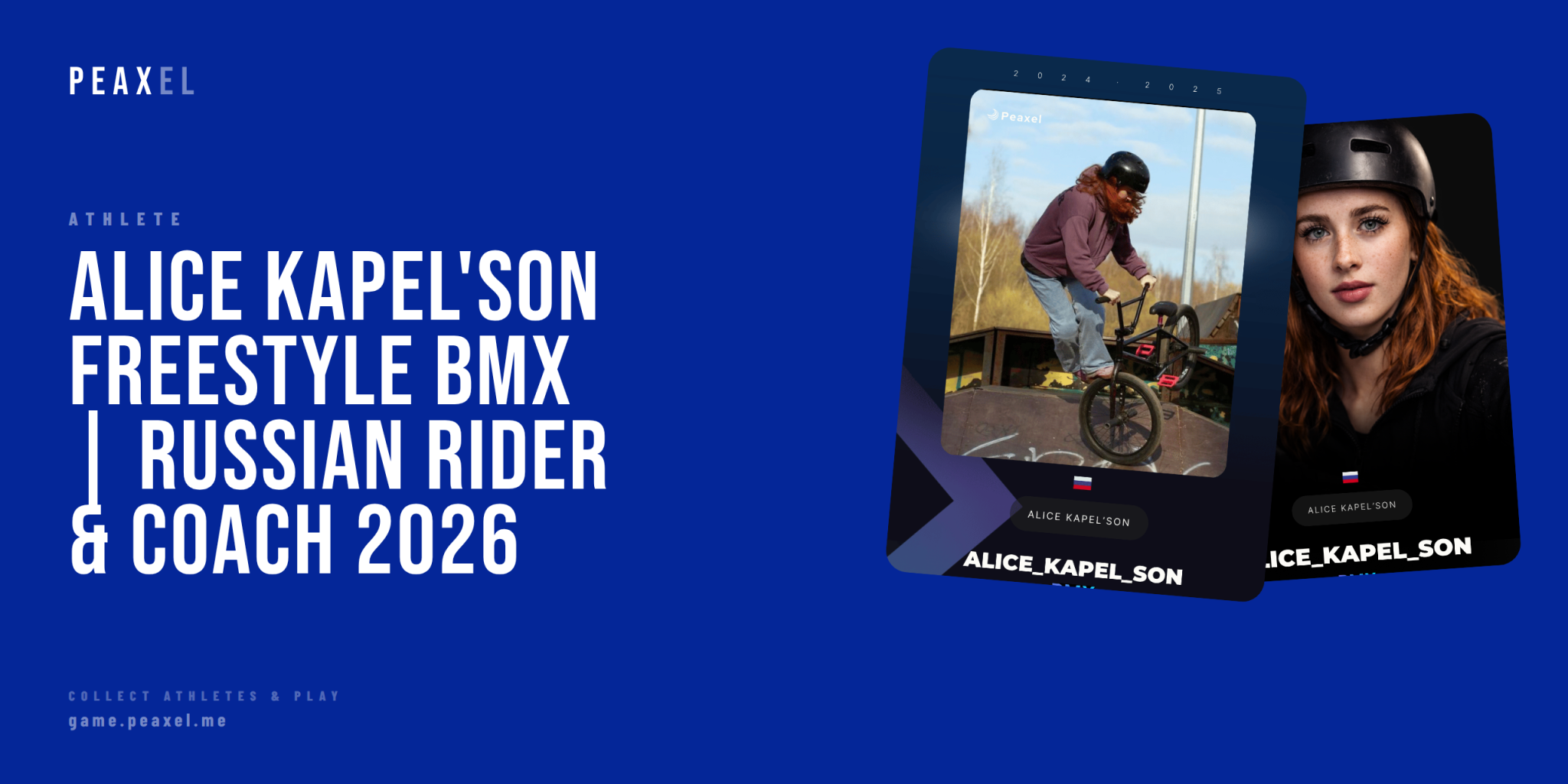
From Multi-Sport Athlete to Freestyle BMX Devotee
Alice Kapel’son (also known as Alisa Kapelson) represents a distinct path into freestyle BMX. Before ever touching a bike, she trained across football, volleyball, swimming, athletics, and rhythmic gymnastics. That multi-sport foundation gave her the body awareness, flexibility, and resilience that would later define her riding style.
In April 2019, inspired by friends already embedded in the Saint Petersburg BMX scene, Alice picked up her first BMX bike. What started as curiosity quickly became commitment. Within months, she was spending every available hour at local skateparks, absorbing the technical vocabulary of freestyle riding.
Building Skills in Saint Petersburg’s Skatepark Scene
Saint Petersburg’s freestyle BMX infrastructure is not comparable to California or the Netherlands. Riders often work with limited facilities, harsh winters, and minimal institutional support. Alice has navigated these constraints by training at multiple parks across the city—and even helping construct DIY setups where official facilities fall short.
This resourcefulness defines much of the Russian freestyle BMX community. Without the sponsorship pipelines common in Western Europe or the United States, riders develop through grassroots networks, shared knowledge, and personal investment. Alice’s progression reflects this reality: self-directed, community-supported, and driven by intrinsic motivation rather than external validation.
Coaching as Career and Community Service
What distinguishes Alice from many riders at her stage is her parallel career as a BMX trainer. She works directly with younger and newer riders in Saint Petersburg, passing on technical skills while also modeling what a sustainable relationship with the sport can look like.
Coaching in freestyle BMX is rarely lucrative. Most trainers operate through local clubs, private sessions, or informal arrangements. For Alice, this work is both a livelihood and a form of scene-building. Every rider she develops strengthens the local talent pool and expands the community that makes her own riding possible.
Her athletic background gives her unusual coaching versatility. She understands progression from multiple angles—how gymnastics teaches air awareness, how swimming builds endurance, how team sports develop mental resilience under pressure. These cross-training insights inform her approach with students.
The Economics of Freestyle BMX in Russia
Sponsorship in freestyle BMX operates on a tiered system. At the top, riders with global visibility secure deals with bike manufacturers, apparel brands, and energy drink companies. Below that tier, most riders—including those competing at national level—piece together partial support or remain entirely self-funded.
For Russian riders specifically, geopolitical factors have complicated international sponsorship opportunities since 2022. Some brands have withdrawn from the market entirely; others have scaled back partnerships. This leaves athletes like Alice operating in a sponsorship environment even more constrained than it was five years ago.
The practical result is that coaching becomes essential. It provides income, keeps riders connected to the sport during periods when competition opportunities are limited, and creates a feedback loop where experienced riders invest in the next generation rather than exiting the scene entirely.
Comparison: Different Paths in Freestyle BMX
While Alice builds the sport locally in Russia, riders like Dylan Devitt in Australia demonstrate what’s possible with different resources and exposure. Devitt gained global attention in 2023 for landing the world’s first “360 Nothing Front Bike Flip”—a trick requiring 700 attempts over 11 days. That kind of documentation and distribution depends on media infrastructure Alice doesn’t have immediate access to.
The contrast isn’t about talent. It’s about ecosystem. Both riders share dedication to progression and community contribution. The difference lies in what their respective scenes can offer and amplify.
What Makes Freestyle BMX Coaching Distinctive
Unlike gymnastics or figure skating, freestyle BMX has no universal coaching certification system. Quality varies enormously. Some coaches are former competitors with deep technical knowledge; others are enthusiasts with limited formal training.
Alice’s multi-sport background positions her unusually well. She understands periodization from athletics, spatial awareness from gymnastics, and the psychological management of fear that any aerial sport requires. These elements combine into a coaching philosophy that addresses not just tricks but the complete athlete development process.
Her students benefit from this breadth. Learning a new trick isn’t just about repetition—it’s about understanding body position, managing fatigue, building confidence incrementally, and recovering from falls without psychological damage. These are skills that transfer across disciplines and careers.
The Freestyle BMX Community as Support System
In cities without major competitive infrastructure, the local community becomes everything. Riders share equipment knowledge, spot each other on new tricks, and create the social fabric that makes the sport sustainable over years rather than months.
Alice’s involvement in Saint Petersburg’s scene exemplifies this. By both riding and coaching, she occupies multiple roles that reinforce each other. Her visibility as an active rider gives her coaching credibility. Her coaching connects her to the motivations and challenges of newer riders, keeping her own perspective fresh.
This dual identity—competitor and coach simultaneously—is increasingly common in action sports where professional pathways remain narrow. It represents a model for how athletes can build careers around sports that don’t offer traditional employment structures.
Discovering Athletes Like Alice on Peaxel
Peaxel exists to surface athletes like Alice Kapel’son—riders building their sports from the ground up, often without the visibility that major competitions provide. Through the platform, fans can explore her profile, follow her progression, and engage with freestyle BMX at a level beyond headline names.
For those interested in the full range of action sports represented on the platform, the complete sports directory offers a starting point for discovering athletes across dozens of disciplines worldwide.