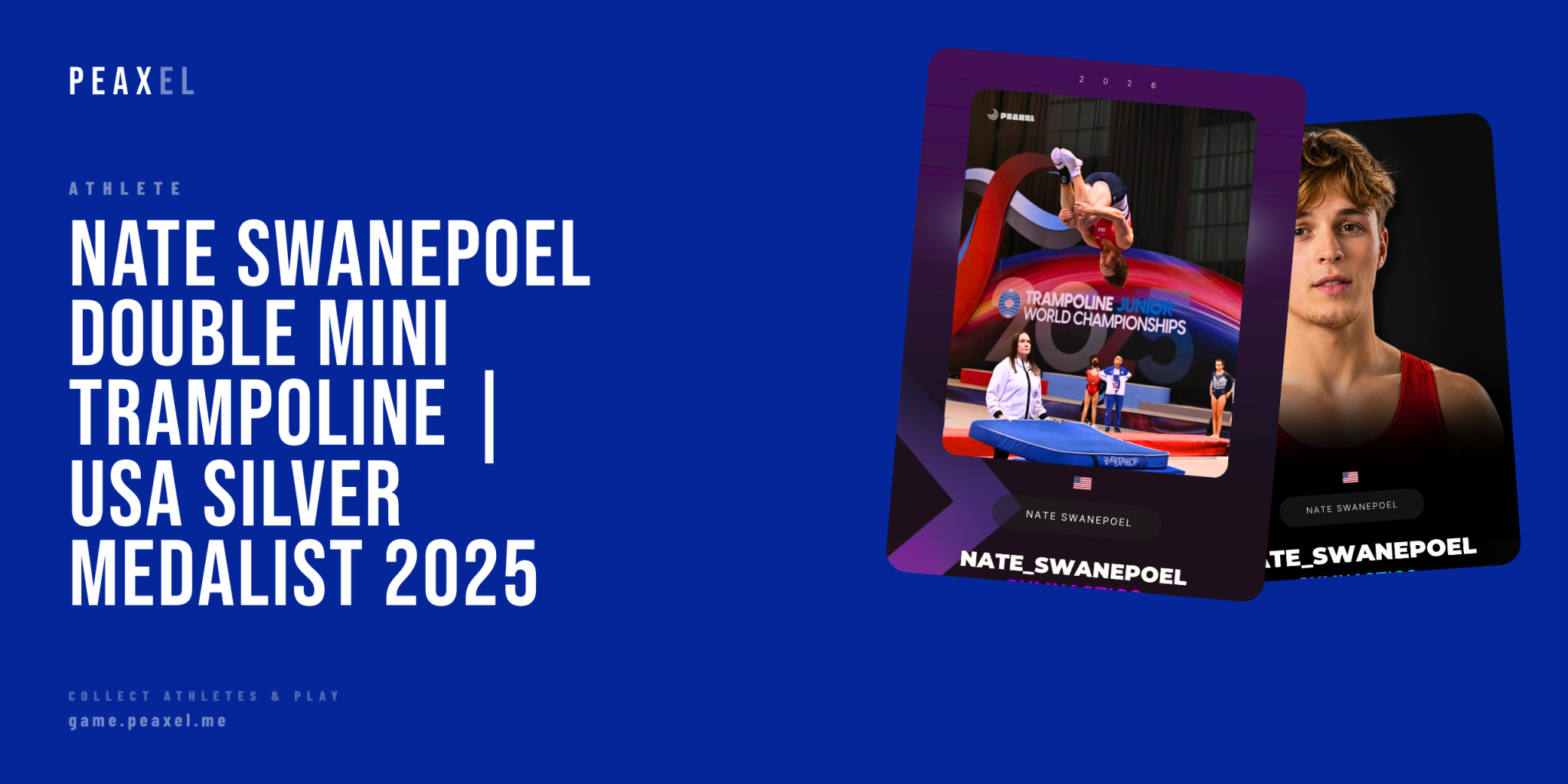
A Raffle Ticket That Changed Everything
Some athletic careers begin with childhood dreams and years of deliberate planning. Nate Swanepoel‘s journey into double mini trampoline started with a raffle ticket at Brook Knoll Elementary School in Scotts Valley, California. His parents entered a drawing, won a free week at Vargas Academy of Gymnastic Arts, and signed their son up for parkour classes.
That plan lasted approximately five minutes. When the young Swanepoel walked into the facility and saw trampoline gymnasts launching themselves through the air, executing complex aerial skills with apparent effortlessness, he knew immediately what he wanted to do. He switched disciplines on the spot and never looked back.
Under the guidance of coach Vernon Vargas, Swanepoel discovered what he describes as the feeling of flying. Double mini trampoline—often abbreviated as DMT—became his obsession, his craft, and ultimately his path to representing the United States on the world stage.
Understanding Double Mini Trampoline
Double mini trampoline occupies a unique space within gymnastics. Athletes sprint down a runway at full speed, mount an angled trampoline apparatus, and execute two distinct aerial skills before sticking a landing on a mat. The discipline demands explosive power, precise body control, and the courage to commit fully to complex rotations while traveling through space.
Unlike individual trampoline, where athletes perform on a stationary bed, DMT requires forward momentum and split-second timing. The mount phase and dismount phase each present different technical challenges. Judges evaluate difficulty, execution, and landing stability—meaning athletes must balance ambition with precision.
The sport rewards creativity and progression. As athletes develop, they add more rotations, more twists, and more complex combinations. Swanepoel has embraced this progression, pushing his difficulty scores while maintaining the execution quality that separates elite competitors from the rest.
The Road to Pamplona
Swanepoel’s path to international competition was not without obstacles. A serious foot injury threatened to derail his career entirely, forcing him through a difficult rehabilitation period. The comeback required patience, discipline, and the mental fortitude to return to high-level training without fear.
He made a full recovery and earned selection to Team USA for the 2025 FIG Trampoline World Age Group Competitions in Pamplona, Spain. Competing in the 17-21 age division, Swanepoel entered the competition with confidence built through years of preparation at Vargas Academy and later with the USA Gymnastics national program.
In qualification, he scored 55.200 points, placing second and demonstrating the consistency that coaches value in high-pressure competition. The final delivered even more: Swanepoel claimed the silver medal for the United States, one of the standout American results of the entire competition.
Training at the Elite Level
Today, Swanepoel trains at North Valley Gymnastics in Phoenix, Arizona, while pursuing his studies at Arizona State University. The dual commitment to academic and athletic excellence reflects the reality facing many American gymnasts who compete in disciplines outside the mainstream spotlight.
Double mini trampoline does not carry the same visibility as artistic gymnastics events like vault or floor exercise. Athletes in the discipline must often self-fund travel to international competitions and balance training with other life responsibilities. Swanepoel’s silver medal in Pamplona represents not just athletic achievement but the kind of dedication required to excel in a sport that operates largely outside the public eye.
His training regimen focuses on building the explosive leg power necessary for high-difficulty mounts and the aerial awareness required to control complex rotations. Each pass is a calculated risk—athletes must commit fully to skills that happen faster than conscious thought allows. The margin between a perfect landing and a costly error is measured in fractions of a second.
The American Double Mini Trampoline Scene
The United States has produced several notable double mini trampoline athletes in recent years, and Swanepoel joins a generation pushing the sport forward. Fellow American Taj Gleitsman, who also competed at the 2025 World Age Group Competitions, represents another young talent emerging from the American system.
USA Gymnastics has invested in developing DMT athletes through national team programs and competitive pathways that identify promising juniors and provide them with international experience. Swanepoel’s journey from Vargas Academy through the national program to a world-level silver medal illustrates how this development pathway functions when an athlete possesses both talent and determination.
What Comes Next
At 20 years old, Swanepoel has time to continue developing his difficulty scores and execution quality. The senior World Championships represent the next competitive frontier, where he would face established athletes from powerhouse nations like Russia, China, and Portugal.
Double mini trampoline continues to evolve as a discipline, with athletes around the world pushing the limits of what is physically possible on the apparatus. Swanepoel has already demonstrated he belongs in the conversation about the sport’s future—his silver medal in Pamplona was not a ceiling but a foundation.
For fans interested in following his journey, Peaxel offers a platform to discover and support athletes like Swanepoel across a wide range of sports and disciplines. His profile on Peaxel’s game platform provides another way to engage with his career as it unfolds.
What began with a lucky raffle ticket has become something far more significant: a career built on talent, resilience, and the pure joy of feeling like you can fly.