What Makes Synchronized Trampoline Different
Synchronized trampoline is one of the most visually spectacular disciplines in gymnastics. Two athletes perform identical 10-element routines on side-by-side trampolines, launching up to 8 meters into the air while maintaining perfect timing with each other. The margin for error is measured in fractions of a second.
Unlike individual trampoline where one athlete performs alone, synchronized trampoline adds an entirely separate dimension of judgment: how well two bodies move as one. This creates a unique scoring system that balances technical execution with the art of synchronization.
The Three Pillars of Synchronized Trampoline Scoring
The Fédération Internationale de Gymnastique (FIG) governs synchronized trampoline scoring through three distinct components: execution, difficulty, and synchronization. Each component is evaluated by separate judging panels to ensure objectivity and precision.
Execution Score
Five execution judges evaluate each athlete individually, assessing the technical quality of every element performed. Judges look for body position, arm placement, and the precision of rotations and twists. Each element starts from a maximum of 10 points, with deductions taken for bent knees, separated legs, incomplete rotations, or poor body alignment.
The highest and lowest execution scores are dropped, and the remaining three are averaged. This score reflects the individual technical quality of each athlete’s performance, independent of their partner.
Difficulty Score
Difficulty is calculated mathematically based on the tariff values assigned to each element in the FIG Code of Points. A routine consists of 10 elements, and each element has a predetermined difficulty value based on the number of somersaults, twists, and body positions involved.
A double back somersault with a full twist carries a higher tariff than a simple tuck back somersault. The total difficulty score is the sum of all 10 element tariffs. There is no panel of judges for difficulty—it is purely computational.
Synchronization Score
This is what separates synchronized trampoline from individual competition. Three synchronization judges evaluate how closely the two athletes mirror each other throughout the entire routine. Deductions are applied for differences in timing at takeoff and landing, variations in height achieved, and horizontal displacement between athletes.
Synchronization judges compare the athletes at every phase of every element. If one athlete reaches peak height 0.2 seconds before their partner, deductions are applied. If one athlete travels sideways while the other remains centered, deductions are applied. The synchronization score can range from 0 to 10, with 10 representing theoretical perfection.
How the Final Score is Calculated
The final score in synchronized trampoline combines all three components. The formula adds the execution scores of both athletes (after dropping high and low), the total difficulty tariff, and the synchronization score. Penalties for landing outside the marked zone or failing to complete an element are subtracted from this total.
A world-class synchronized trampoline routine typically scores between 48 and 54 points. At the 2025 World Games in Chengdu, top pairs regularly exceeded 50 points, demonstrating the extreme precision required at elite level.
Common Deductions in Synchronized Competition
Understanding where points are lost helps fans appreciate the difficulty of synchronized trampoline. The most common deductions include:
Timing desynchronization: When one athlete lands or takes off visibly before their partner, judges apply incremental deductions. A difference of 0.1 seconds may result in a 0.1 deduction, while larger timing gaps lead to proportionally larger penalties.
Height differential: If one athlete consistently bounces higher than their partner, synchronization judges penalize the pair. Athletes must match not only timing but also the vertical amplitude of their jumps.
Travel: When athletes drift horizontally across the trampoline bed, they accumulate deductions. Travel is particularly penalized when it causes visible separation between the two performers.
The Role of Training in Achieving Synchronization
Elite synchronized trampoline pairs train together for years to develop the instinctive timing required for competition. Partners must match their physical characteristics—height, weight, and jumping power—to ensure natural synchronization.
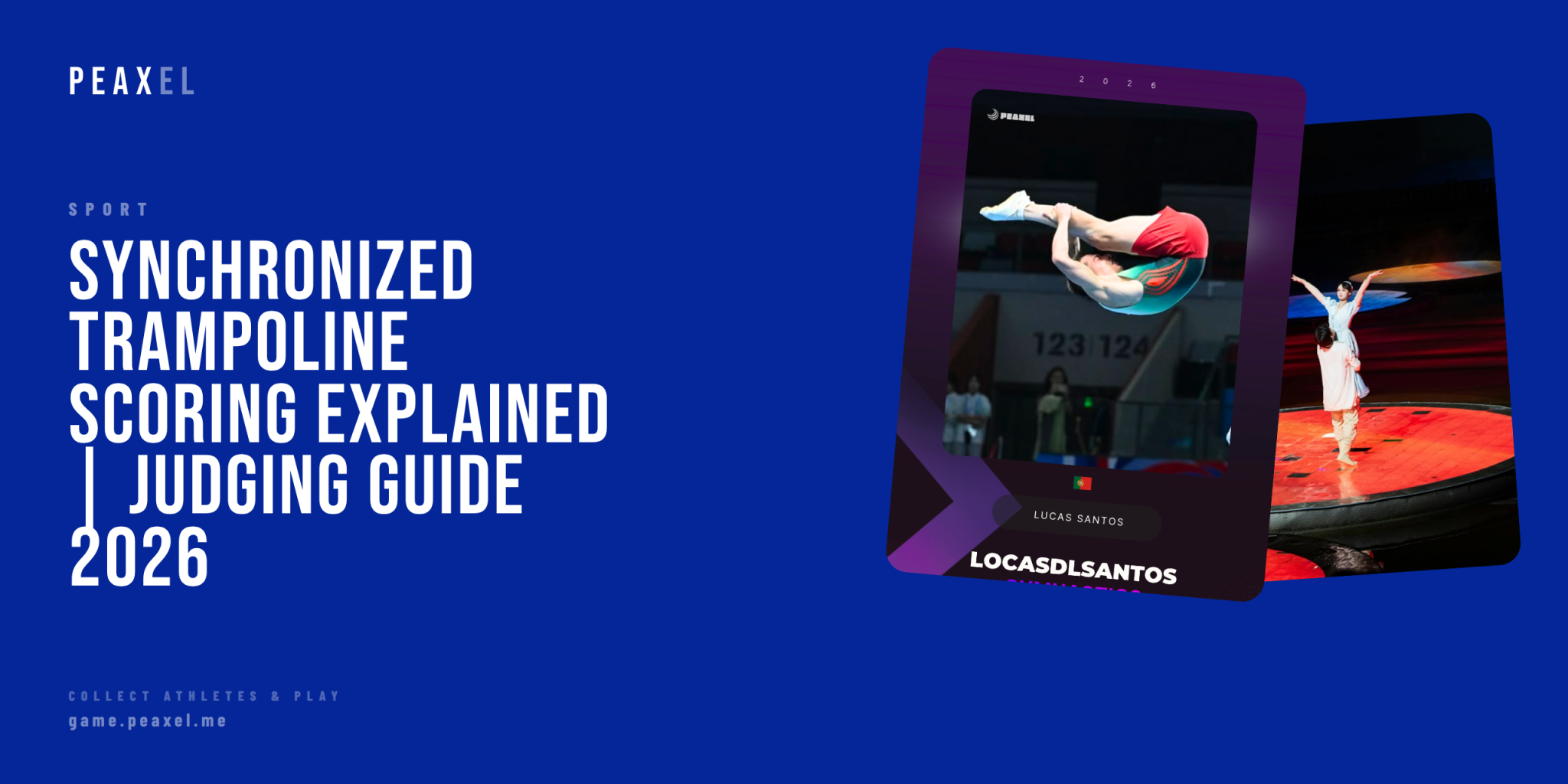
Athletes like Lucas Santos from Portugal have dedicated their careers to synchronized trampoline excellence. Santos won gold at the 2025 World Games in synchronized trampoline alongside Gabriel Albuquerque, showcasing the results of years of partnership development. You can follow his career on Peaxel.
Japanese athlete Hayato Miyano has similarly excelled in synchronized events, earning silver medals at the 2025 World Championships in both men’s synchronized and mixed synchronized trampoline. His performances demonstrate the versatility required to synchronize with different partners across competition formats.
Mixed Synchronized Trampoline
Mixed synchronized trampoline pairs one male and one female athlete, adding another layer of complexity. Male athletes typically generate more height due to greater jumping power, requiring careful routine construction to maintain visual synchronization.
Judges apply the same scoring criteria but must account for inherent physical differences between partners. The mixed event has gained popularity in recent years, appearing at World Championships and continental competitions as federations push for gender equity in gymnastics programming.
Why Synchronized Trampoline Captivates Audiences
The visual impact of two athletes performing identical aerial maneuvers in perfect unison creates an immediate emotional connection with spectators. Unlike many gymnastics disciplines where technical details escape casual viewers, synchronization—or the lack of it—is instantly visible to everyone watching.
This accessibility makes synchronized trampoline ideal for broadcast and live audiences. The discipline continues to grow globally, with Peaxel featuring synchronized trampoline athletes from Portugal, Japan, the Netherlands, and beyond.
Following Synchronized Trampoline Athletes
For fans wanting to engage more deeply with synchronized trampoline, platforms like Peaxel offer ways to follow and support athletes competing in this demanding discipline. As synchronized trampoline continues its growth trajectory toward potential Olympic inclusion, understanding its scoring system enhances appreciation for every perfectly timed takeoff and landing.