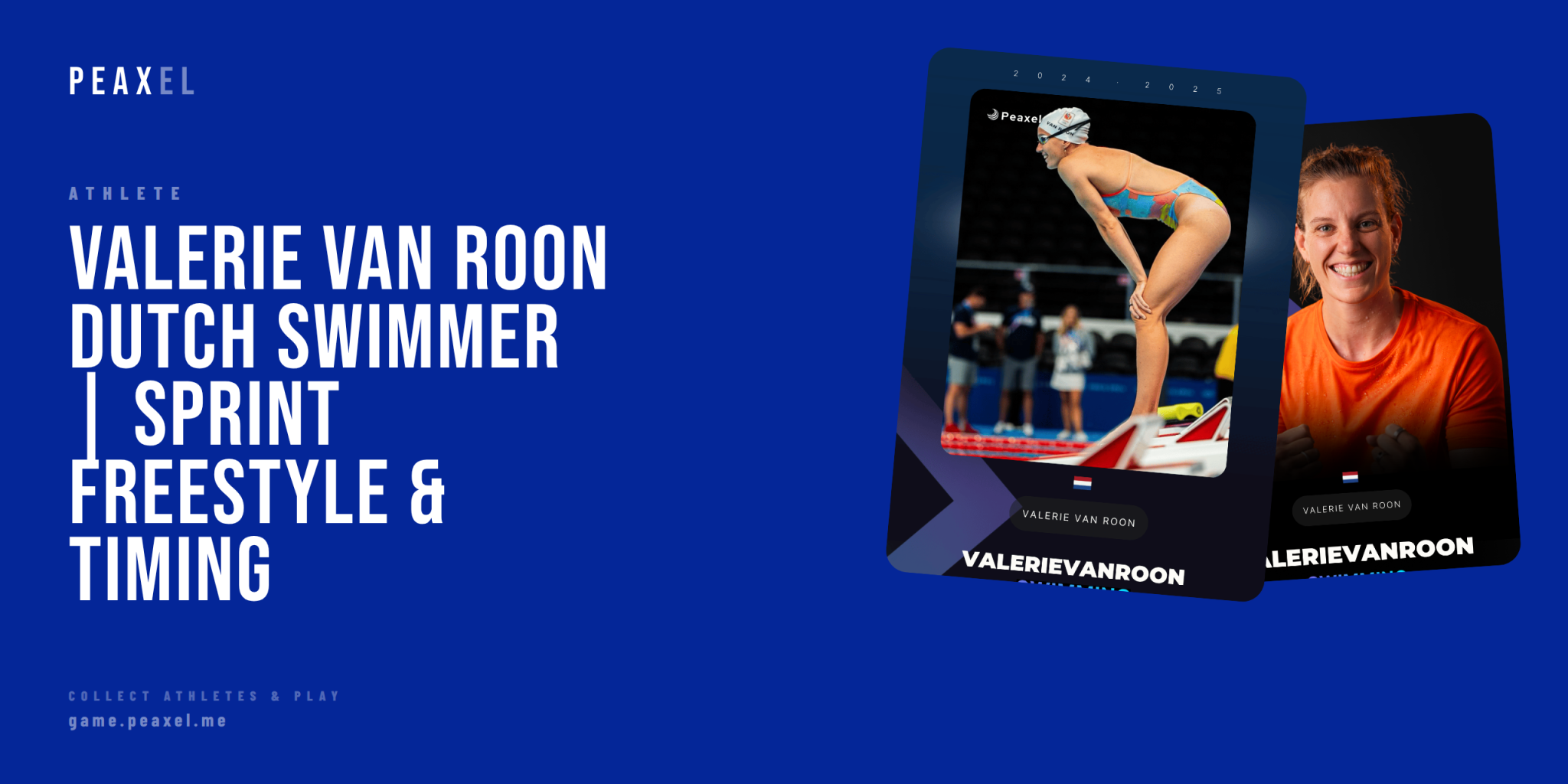
From Delft to the Olympic Pool: Valerie van Roon’s Rise in Sprint Freestyle
In the world of sprint swimming, races are decided by margins so thin they’re invisible to the naked eye. Valerie van Roon, the Dutch sprint freestyle specialist, has built her career navigating these razor-thin margins. Born in Delft, Netherlands, she emerged as one of Europe’s most consistent sprint swimmers through a combination of explosive power, technical precision, and an almost obsessive attention to the details that separate fourth place from the podium.
Van Roon’s international journey began at the 2014 European Junior Championships, where she claimed bronze in the 50m freestyle. That early medal signaled what was to come: a career defined by speed over short distances and an ability to perform when it matters most.
World Record Holder: The Dutch Relay Dominance
The defining moment of Valerie van Roon’s career arrived at the 2017 European Short Course Championships in Copenhagen. Swimming alongside her Dutch teammates, she helped set a world record in the 4×50m freestyle relay with a time of 1:33.91. That record still stands as a testament to the Netherlands’ strength in sprint swimming and van Roon’s ability to deliver under pressure.
World records in relay events require more than individual talent. They demand perfect exchanges, where swimmers must time their dives to leave the block the instant their teammate touches the wall. Electronic timing systems measure these exchanges to the hundredth of a second. A early start by even 0.01 seconds results in disqualification. Van Roon and her teammates executed with precision that day in Copenhagen.
She added to her relay medal collection at the 2018 FINA World Championships, contributing to silver medals in both the 4×50m and 4×100m freestyle relays. In 2019, she helped the Dutch team claim gold in the 4×50m freestyle relay at the European Short Course Championships.
Individual Excellence: Bronze in Budapest and Olympic Qualification
While relays showcased her teamwork, van Roon proved her individual credentials at the 2022 European Aquatics Championships in Rome. She earned bronze in the 50m freestyle, a result that placed her among Europe’s elite sprinters in the most explosive event in the pool.
The 50m freestyle is swimming’s equivalent of the 100m dash in athletics. There’s no room for pacing strategy. Athletes explode off the blocks, maintain maximum effort through the turn, and fight to touch the wall first. Races typically last between 21 and 25 seconds for elite women, meaning every stroke, every breath, every hundredth of a second counts.
In April 2024, van Roon secured her place at the Paris Olympics by swimming a personal best of 24.62 seconds at the Eindhoven Qualification Meeting. That time represented years of refinement in her technique, her starts, and her underwater dolphin kicks off the wall.
How Swimming Timing and Scoring Actually Works
Understanding van Roon’s achievements requires understanding how swimming measures performance. Unlike sports where judges assign scores based on subjective criteria, swimming relies entirely on time. The athlete who touches the wall first wins. But capturing that moment accurately demands sophisticated technology.
Modern competitive swimming uses electronic timing systems with touchpads installed at each end of the pool. These pads, typically manufactured by companies like Omega or Colorado Time Systems, are pressure-sensitive panels that register the exact moment a swimmer’s hand makes contact. The sensitivity threshold is calibrated to distinguish between an intentional touch and the pressure of water movement.
Times are recorded to the hundredth of a second (0.01). At major competitions, if two swimmers record identical times to the hundredth, they are awarded the same place. This happened famously at the 2016 Olympics when Simone Manuel and Penny Oleksiak tied for gold in the 100m freestyle with identical times of 52.70 seconds.
Reaction Time: The Hidden Metric
Beyond finish times, swimming tracks reaction time—the interval between the starting signal and when a swimmer’s feet leave the block. Reaction times are measured by pressure sensors in the starting blocks. A reaction time under 0.10 seconds is considered a false start, resulting in disqualification. Elite swimmers typically react between 0.60 and 0.75 seconds.
For sprint specialists like van Roon, reaction time is critical. In a 50m race lasting approximately 24-25 seconds, a reaction time advantage of 0.05 seconds represents a significant edge. Training specifically for faster reactions—without going under the 0.10 second threshold—is a key focus for sprint swimmers.
Short Course vs. Long Course: Different Records
Van Roon’s world record came in a short course pool (25 meters), while her Olympic competition took place in a long course pool (50 meters). Swimming maintains separate world records for each pool length because the additional turns in short course racing allow swimmers to exploit their underwater phases, where they can often move faster than when swimming on the surface.
This is why van Roon’s relay world record of 1:33.91 in short course is faster than equivalent long course times. Each turn provides an opportunity for explosive push-offs and underwater dolphin kicks, skills that Dutch swimmers have historically mastered.
The Technical Demands of Sprint Freestyle
Sprint freestyle places unique demands on athletes. Unlike distance events where aerobic endurance dominates, the 50m freestyle is almost entirely anaerobic. Swimmers operate at maximum intensity for the entire race, building up lactic acid with every stroke.
Van Roon’s training balances explosive power development with technique refinement. Sprint swimmers work extensively on starts and turns, since these non-swimming phases can account for 30% or more of total race time in short course events. Video analysis helps athletes identify inefficiencies in their stroke mechanics, while resistance training builds the fast-twitch muscle fibers essential for explosive speed.
The underwater phase after each start and turn is particularly crucial. Swimmers are permitted to travel up to 15 meters underwater before surfacing. Elite sprinters like van Roon use powerful dolphin kicks during this phase to maintain speed generated from the dive or push-off. Breaking the surface too early sacrifices velocity; staying under too long risks disqualification.
What Makes Valerie van Roon a Key Figure in Dutch Swimming
The Netherlands has a proud tradition in swimming, and van Roon represents its continuity. Her consistency across multiple championship cycles—from junior medals in 2014 through Olympic qualification in 2024—demonstrates the sustainability of her approach to the sport.
Her specialization in sprint events, combined with her relay contributions, makes her valuable to the Dutch national team program. Relay medals at major championships carry the same weight as individual medals in the final standings, and having reliable athletes who can deliver consistent splits is essential for any nation competing at the highest level.
You can follow Valerie van Roon’s career and collect her athlete card on Peaxel, where fans can build teams featuring athletes from over 100 sports including swimming. Discover more athletes pushing the limits of human performance at peaxel.me.