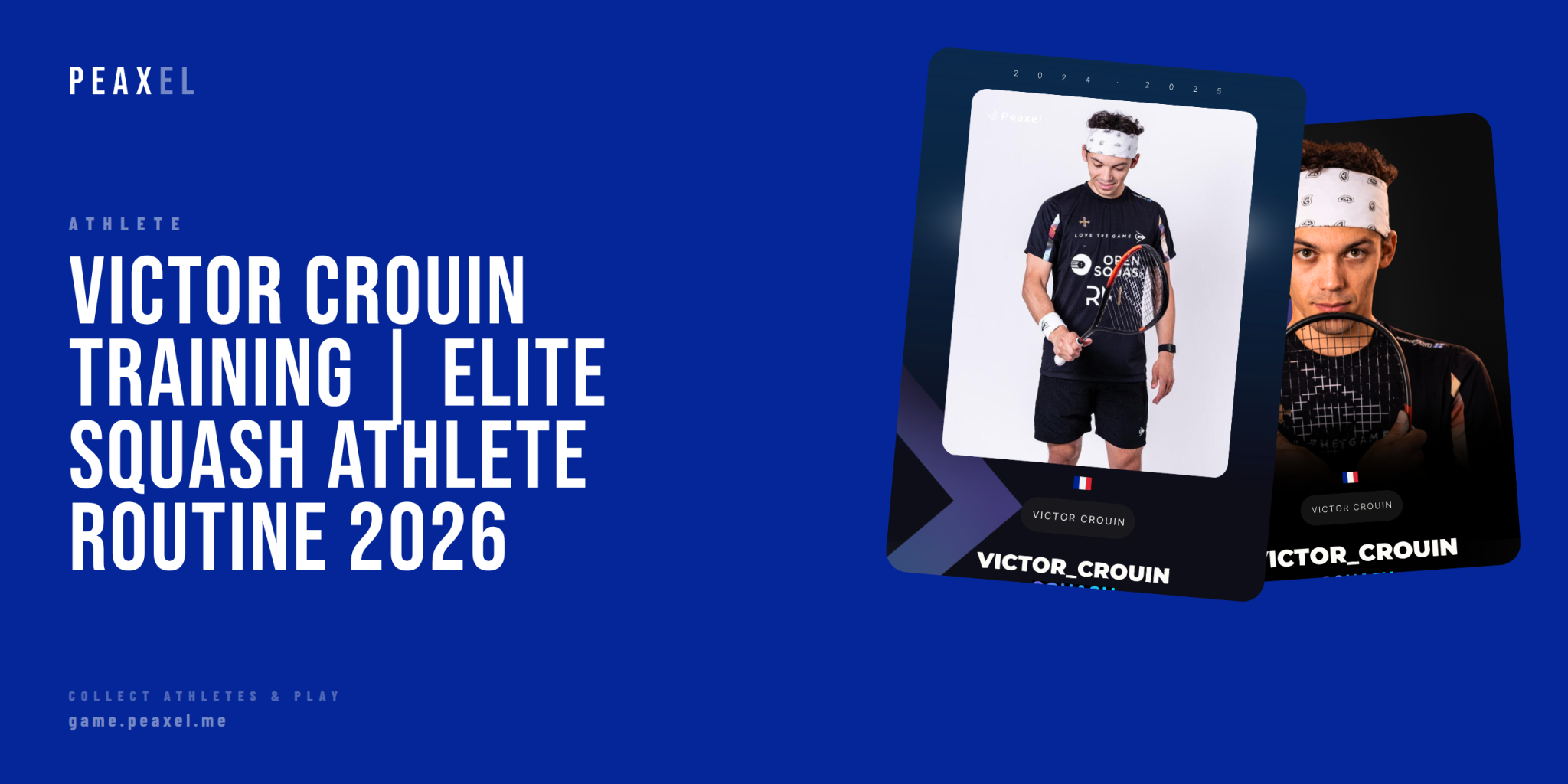
The Making of a Squash Champion
Professional squash demands a rare combination of explosive power, tactical intelligence, and aerobic endurance that few racket sports can match. For Victor Crouin, the three-time European Individual Champion from France, these demands shape every aspect of his daily life. His training regimen reflects the intensity required to compete at the highest level of the PSA World Tour.
Crouin’s journey to elite squash status followed an unconventional path. While many professional players focus exclusively on their sport from a young age, he chose to combine his athletic career with academic pursuits at Harvard University. This dual commitment required exceptional discipline and time management skills that continue to define his approach to training today.
Daily Training Structure
A typical training day for Victor Crouin begins early and divides into distinct phases targeting different aspects of performance. Morning sessions typically focus on physical conditioning, while afternoon work shifts to on-court technical and tactical development.
Physical preparation forms the foundation of Crouin’s training program. Squash players cover between three and five kilometers during a competitive match, often in explosive bursts with minimal recovery time. His conditioning work emphasizes interval training that replicates the stop-start nature of match play, building the aerobic base necessary for five-game battles while developing the anaerobic capacity for explosive court coverage.
Strength training plays a crucial role in injury prevention and power generation. Crouin’s program targets the legs, core, and shoulder complex—the primary muscle groups engaged during rallies. Lower body strength enables the rapid lunging and pushing movements that characterize elite court coverage, while core stability allows players to generate power from compromised positions.
On-Court Technical Work
The technical demands of professional squash require hours of repetitive practice to maintain and refine shot-making ability. Crouin dedicates significant training time to solo drills, including ghosting—the practice of moving to positions on court without a ball to ingrain movement patterns and improve court coverage efficiency.
His tactical intelligence, frequently highlighted by commentators and opponents alike, develops through structured match play and video analysis. Understanding opponent tendencies, recognizing patterns, and exploiting weaknesses require continuous study beyond physical practice. Crouin reviews footage of upcoming opponents and his own performances to identify areas for improvement.
Court sessions with training partners simulate competitive conditions while allowing focus on specific tactical scenarios. These sessions often target particular game situations—playing from defensive positions, converting attacking opportunities, or managing the pace of rallies to control opponents.
Recovery and Regeneration
The physical toll of professional squash makes recovery as important as training itself. Crouin incorporates multiple recovery modalities into his weekly schedule, including sports massage, stretching protocols, and adequate sleep. The PSA Tour calendar, with events spanning multiple continents, adds travel fatigue to the recovery equation.
Nutrition supports both training adaptation and match performance. Squash players must maintain lean body composition for optimal court movement while ensuring adequate fuel for intensive training blocks. Hydration receives particular attention given the enclosed court environment where temperatures can rise significantly during extended rallies.
Mental Preparation
Squash places exceptional mental demands on competitors. Matches can shift momentum rapidly, and maintaining composure during critical moments often determines outcomes. Crouin’s approach to mental preparation includes visualization techniques, breathing exercises, and pre-match routines designed to optimize focus and arousal levels.
His experience balancing Harvard academics with professional competition developed mental resilience that translates directly to tournament play. Managing pressure, maintaining concentration through long matches, and recovering mentally between tournament rounds all reflect skills honed through years of dual commitment.
Tournament Preparation Cycles
The PSA World Tour calendar requires careful periodization of training loads. Crouin structures his season around major events, building fitness bases during lighter competitive periods and shifting toward maintenance and sharpening as key tournaments approach. The 2026 Texas Squash Open title demonstrated the effectiveness of this approach, with Crouin peaking at the right moment to claim victory.
International travel between events introduces additional challenges. Adapting to different court conditions, managing jet lag, and maintaining training consistency across various locations requires flexibility and experience. Elite players develop portable routines that can be replicated regardless of location.
The Harvard Influence
Crouin’s time at Harvard shaped his approach to training in ways that distinguish him from many peers. The academic environment demanded efficient use of time—a skill that carries over to professional life where training must be maximized within available hours. His analytical mindset, developed through university study, informs his tactical preparation and match analysis.
The American collegiate squash system also exposed him to different playing styles and training methodologies. This diverse experience broadened his tactical repertoire and competitive perspective, contributing to the adaptability that characterizes his professional career.
Representing France at Elite Level
As one of France’s most successful squash players, Crouin carries national expectations into major competitions. His three consecutive European Individual Championship titles (2022, 2023, 2024) and World Games gold medal in 2022 established him as the leading figure in French squash. This status brings both motivation and pressure that inform his training approach.
Representing France in team competitions adds another dimension to his preparation. Team events require different tactical considerations and the ability to perform on demand rather than through the accumulation of tournament rounds. Crouin’s training includes specific preparation for these formats when national team events approach.
The Path Forward
At this stage of his career, Victor Crouin continues refining his game while maintaining the physical condition necessary for sustained excellence. His training philosophy emphasizes continuous improvement—identifying weaknesses, developing new tactical options, and building the fitness levels required to compete with the world’s best players across five-game matches.
The demands of professional squash show no signs of decreasing. Players are bigger, faster, and more athletic than previous generations, raising the physical baseline for elite competition. Crouin’s training program evolves accordingly, incorporating new methodologies and technologies to maintain competitive advantage.
For fans interested in following Victor Crouin’s career and exploring the world of professional squash, his athlete profile is available on Peaxel. The platform features athletes across dozens of sports, from squash to the full range of disciplines covered on Peaxel’s comprehensive sports list.