What Makes Vault Scoring Different From Other Gymnastics Events
Vault is the shortest and most explosive event in artistic gymnastics. Athletes sprint down a runway, launch off a springboard, push off the vaulting table, and execute aerial skills before landing. The entire sequence lasts roughly five seconds, yet judges must evaluate dozens of technical elements in that brief window.
Unlike floor exercise or balance beam, where routines can exceed 90 seconds, vault condenses all evaluation into a single explosive action. This compression makes the scoring system both precise and unforgiving. Every degree of rotation, every centimeter of hand placement, and every wobble on landing affects the final score.
Understanding vault scoring unlocks appreciation for why certain vaults dominate elite competition and why a seemingly perfect landing can still receive deductions.
The Two-Part Scoring System: D-Score and E-Score
Artistic gymnastics uses a two-component scoring system governed by the Fédération Internationale de Gymnastique (FIG) Code of Points. The vault score combines a Difficulty Score (D-score) and an Execution Score (E-score).
D-Score: The Difficulty Value
Every vault in the FIG code is assigned a predetermined difficulty value. This value reflects the complexity of the vault’s entry, flight phase, and aerial elements. A Yurchenko double pike, for example, carries a higher D-score than a simple Yurchenko layout because it requires an additional somersault rotation.
The D-score is fixed before the gymnast even begins the runway. Coaches submit the intended vault to judges, and that vault’s value from the official table becomes the starting point. Athletes cannot earn bonus difficulty on vault—they either complete the registered vault or receive a different (usually lower) value if they perform something else.
E-Score: Execution Quality
The E-score starts at a maximum of 10.000 points. A panel of judges watches the vault and subtracts for every execution error they observe. These deductions accumulate throughout the vault’s phases: the run, the board contact, the table push, the flight, and the landing.
Common deductions include bent knees during flight (0.10 to 0.30), insufficient height (0.10 to 0.50), body angle deviations (0.10 to 0.30), and landing errors. The final E-score reflects how cleanly the gymnast performed the vault relative to perfect execution.
How Judges Evaluate Each Phase of the Vault
The Run and Board Contact
Judges begin watching from the first step. A controlled, accelerating run generates the power needed for complex vaults. Hesitation, deceleration, or a stuttered approach can indicate lack of confidence and may correlate with execution problems that follow.
The springboard contact is critical. Judges look for both feet hitting the board simultaneously with appropriate force. A staggered step or weak punch affects the subsequent flight trajectory.
The Table Contact
In modern gymnastics, athletes push off a vaulting table set at 125 centimeters for women and 135 centimeters for men. Judges evaluate hand placement, shoulder angle, and the quality of the block (the explosive push that generates height and rotation).
Hands should contact the table simultaneously and near the center or far end. A weak block—where the gymnast appears to roll over the table rather than spring off it—results in deductions and typically reduces flight height.
The Flight Phase
This is where most vault difficulty lives. Judges assess body shape (tight legs, pointed toes, straight lines), rotation quality, and whether the gymnast achieves sufficient height and distance. A vault that travels too close to the table lacks power; one that travels excessively far may indicate loss of control.
For vaults with twists or multiple somersaults, judges watch for completion of rotations before landing. Under-rotation is a significant deduction and often leads to landing errors.
The Landing
Landing deductions are the most visible to casual viewers. The FIG code specifies precise penalties: a small step costs 0.10, a large step costs 0.30, and a fall costs 1.00. Stepping out of bounds adds further deductions.
The ideal landing is a “stick”—both feet hit the mat simultaneously with no subsequent movement. Stuck landings dramatically improve E-scores and often separate medal contenders from the rest of the field.
The Final Score Calculation
The final vault score is simply the D-score plus the E-score. If an athlete performs a vault with a 5.400 D-score and receives a 9.100 E-score, the final is 14.500.
In vault finals at major competitions, athletes perform two different vaults. The final ranking uses the average of both scores. This format rewards versatility—gymnasts must master multiple high-difficulty vaults rather than repeating their best one.
Why Certain Vaults Dominate Elite Competition
The strategic calculus is straightforward: maximize D-score while maintaining clean execution. Elite gymnasts select vaults at the edge of their capability, where the difficulty value outweighs expected execution deductions.
The Yurchenko family of vaults dominates women’s competition because the round-off entry onto the springboard allows natural power generation. Adding twists and flips to the basic Yurchenko structure increases difficulty without fundamentally changing the mechanics.
In men’s vault, the Tsukahara and Kasamatsu entry styles remain popular, with athletes adding double and triple twists to reach competitive D-scores above 5.600.
Recent Code Changes Affecting Vault Scoring
The FIG updates the Code of Points every Olympic cycle. The 2022-2024 code adjusted several vault difficulty values and refined landing deduction scales. Some vaults were upgraded to encourage progression; others were downgraded when they became too common at lower difficulty tiers.
These periodic adjustments keep the sport evolving. Gymnasts and coaches monitor code changes closely, as a vault that was strategically optimal in one cycle may become less competitive after updates.
Vault Scoring in Context: Athletes Pushing Boundaries
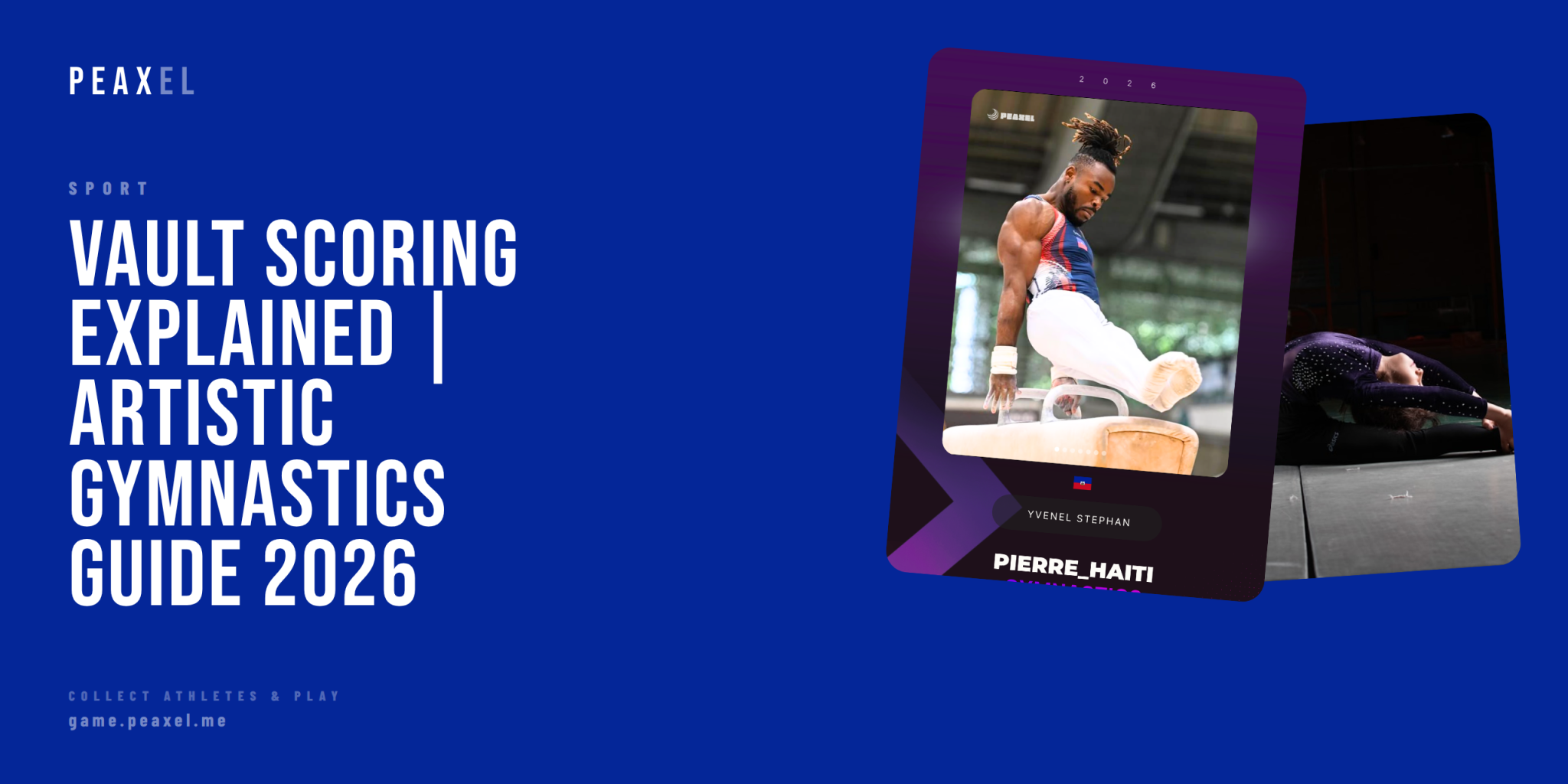
Understanding the scoring system illuminates why athletes take calculated risks. A gymnast like Yvenel Stephan, representing Haiti as the first male gymnast from his nation, must weigh difficulty selection against execution consistency when competing at FIG World Cup events. Every tenth of a point matters when pursuing qualification spots.
Vault rewards explosive power and precision equally. The athletes who master both—generating enough force for high-difficulty vaults while maintaining the body control for clean execution—rise to the top of world rankings.
How to Watch Vault With Informed Eyes
Next time you watch vault competition, focus on three elements: the height achieved above the table, the body shape during flight, and the landing mechanics. These three factors account for most E-score variation between elite gymnasts.
Listen for the announced D-score before each vault. Compare it mentally to the execution you observe. Over time, you will develop an intuitive sense for whether a vault will score in the 14s, the 15s, or higher.
Vault may be gymnastics’ shortest event, but its scoring system captures decades of technical evolution. For fans exploring gymnastics through platforms like Peaxel, understanding how judges arrive at those numbers transforms passive viewing into active analysis—and deepens appreciation for every athlete who sprints down that runway.