What Is E-MTB Enduro Racing?
E-MTB enduro racing combines the technical challenge of traditional enduro mountain biking with electric pedal-assist technology. Riders navigate timed downhill stages while using motor assistance to climb between stages. The format has exploded in popularity since the UCI introduced official E-MTB World Championships in 2019.
Unlike traditional enduro where climbing fitness separates competitors, E-MTB levels the playing field on ascents. This shifts competitive focus almost entirely to descending ability and technical skill. The result is a discipline that attracts both enduro specialists and riders seeking a more accessible entry point into competitive mountain biking.
UCI Regulations Defining E-MTB Equipment
All E-MTB enduro racing equipment must comply with strict UCI regulations. Motors are capped at 250 watts of continuous power. Pedal assistance cuts off completely at 25 kilometers per hour. These limits ensure riders still work on climbs while preventing motors from providing advantage on descents.
Battery capacity is unrestricted, but weight considerations keep most race setups between 500Wh and 750Wh. Bikes must weigh under 25 kilograms total. Frame geometry follows standard mountain bike rules with no additional structural modifications allowed for motor integration.
Motor Systems Powering Competition
Shimano EP8 and EP801
Shimano’s EP8 motor remains the dominant choice in E-MTB enduro racing through 2026. Weighing just 2.6 kilograms, it delivers 85Nm of torque with responsive power delivery. The EP801 variant introduced refined tuning options for racers seeking more aggressive assistance curves.
Shimano’s system integrates cleanly with most frame designs, allowing manufacturers to optimize geometry without compromise. Battery communication protocols enable precise range management during multi-stage races.
Bosch Performance Line CX
Bosch’s Performance Line CX offers 85Nm torque in a 2.9-kilogram package. Its extended boost mode provides sustained power output on steep technical climbs. Many privateer racers prefer Bosch for its reliability and widespread service network.
The system’s eMTB mode automatically adjusts assistance based on pedaling input and gradient. This adaptive response reduces rider fatigue during long liaison stages between timed sections.
Specialized SL 1.2
Specialized developed the SL 1.2 motor specifically for lightweight E-MTB applications. At 1.95 kilograms with 50Nm torque, it powers the Turbo Levo SL platform favored by riders prioritizing handling over raw climbing power.
The reduced weight creates a bike feel closer to traditional enduro machines. Racers trade some climbing advantage for superior descending confidence and maneuverability.
Suspension Technology for E-MTB
E-MTB enduro bikes require suspension systems calibrated for increased overall weight. Most race setups run 160mm to 170mm travel front and rear. Spring rates and damping curves differ significantly from standard enduro specifications.
Fox and RockShox dominate the race scene with E-MTB-specific fork and shock tunes. These setups feature stiffer compression damping to prevent excessive squat under motor torque. Rebound circuits are also firmed up to maintain composure at speed.
Air spring pressures typically run 10 to 15 PSI higher than equivalent rider weight on traditional bikes. This compensates for the additional 5 to 8 kilograms of motor and battery mass centered low in the frame.
Frame Geometry and Design
Modern E-MTB enduro frames integrate motors into the bottom bracket area with minimal visual distinction from acoustic bikes. Chainstay lengths often extend 5 to 10mm longer than traditional enduro geometry to accommodate motor housings and maintain climbing traction.
Head angles typically sit between 63 and 65 degrees, matching aggressive enduro standards. Reach measurements have grown progressively longer as riders seek stability at high speeds. Size large frames commonly exceed 490mm reach in 2026 designs.
Carbon fiber construction has become standard at race level despite the weight penalty being less critical than in traditional MTB. The material’s stiffness and vibration damping properties outweigh pure weight savings when motor assistance handles climbing loads.
Wheels and Tires for E-MTB Enduro
The 29-inch wheel standard dominates E-MTB enduro racing. Larger diameter wheels roll over obstacles more efficiently and maintain momentum—critical when descending times determine results. Some riders run mixed wheel setups with 27.5-inch rear wheels for tighter handling.
Tire selection skews toward reinforced casings designed for the additional forces generated by motor torque. Brands like Maxxis, Schwalbe, and Vittoria offer E-MTB-specific compounds with harder sidewalls and puncture protection layers.
Tread patterns follow traditional enduro preferences with aggressive knobs for loose conditions and semi-slick centers for hardpack. Tire pressures often run 2 to 4 PSI higher than acoustic bike setups to prevent rim strikes under the increased system weight.
Cockpit and Control Components
Dropper seatposts remain essential equipment, with 170mm to 200mm drop ranges standard on race bikes. Riders frequently adjust saddle height during stages to optimize climbing efficiency and descending freedom.
Handlebar widths typically range from 780mm to 800mm, providing leverage for controlling heavier machines through technical terrain. Shorter stems between 35mm and 50mm pair with long reach frames for centered, aggressive positioning.
Brake systems require enhanced stopping power for the increased mass. Four-piston calipers with 200mm or 220mm rotors have become minimum specifications. Metallic brake pads handle heat buildup better than organic compounds during extended descents.
Athletes Competing in E-MTB Enduro
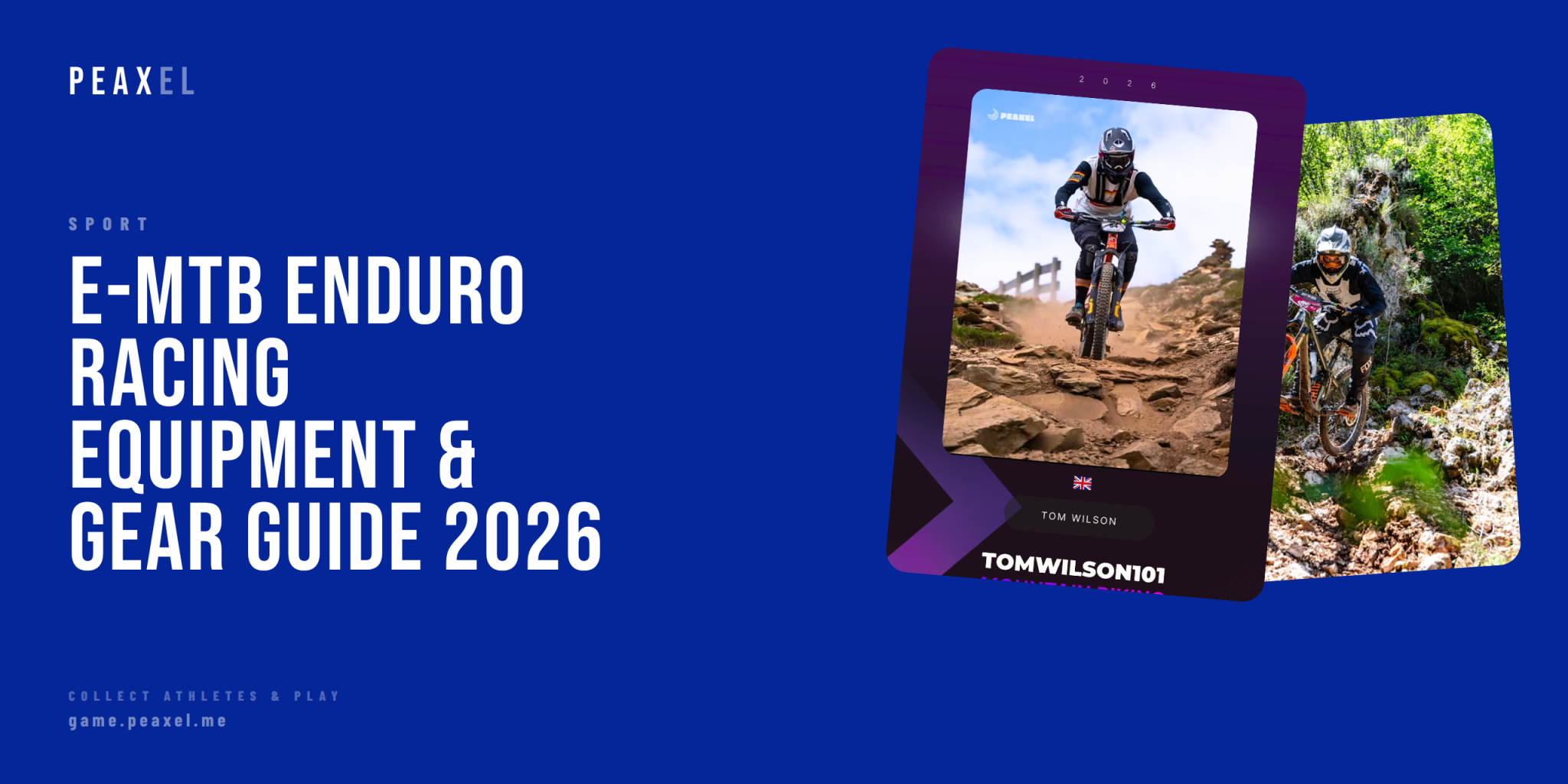
The E-MTB enduro scene attracts riders from traditional enduro backgrounds alongside athletes new to competitive mountain biking. Tom Wilson, a UK-based professional competing internationally in both enduro and E-MTB events, represents the crossover talent entering the discipline. His participation in World Cup enduro and E-MTB competitions showcases how athletes navigate between the two formats.
Fans can follow E-MTB athletes and explore the sport through platforms like Peaxel, where mountain biking and other action sports are featured in a fantasy sports format connecting riders with global audiences.
The Future of E-MTB Equipment
Motor efficiency continues improving with each generation. Weight savings of 200 to 300 grams per motor revision accumulate into significantly lighter race platforms. Battery energy density advances promise longer range without increased mass.
Integration between motor systems and electronic suspension is emerging as the next frontier. Automatic damping adjustments based on terrain detection and power output could fundamentally change how E-MTB enduro bikes handle varied conditions.
As the discipline matures, equipment standardization may tighten through updated UCI regulations. For now, E-MTB enduro racing remains a proving ground where innovation directly translates to competitive advantage. Riders and fans tracking the sport’s evolution can explore the full range of disciplines featured on Peaxel’s sports directory.